The Cambridge CRF Radiofrequency Ablation System supports a wide range of applications in the thyroid, liver, kidney, bone, lung, and beyond using a single platform.
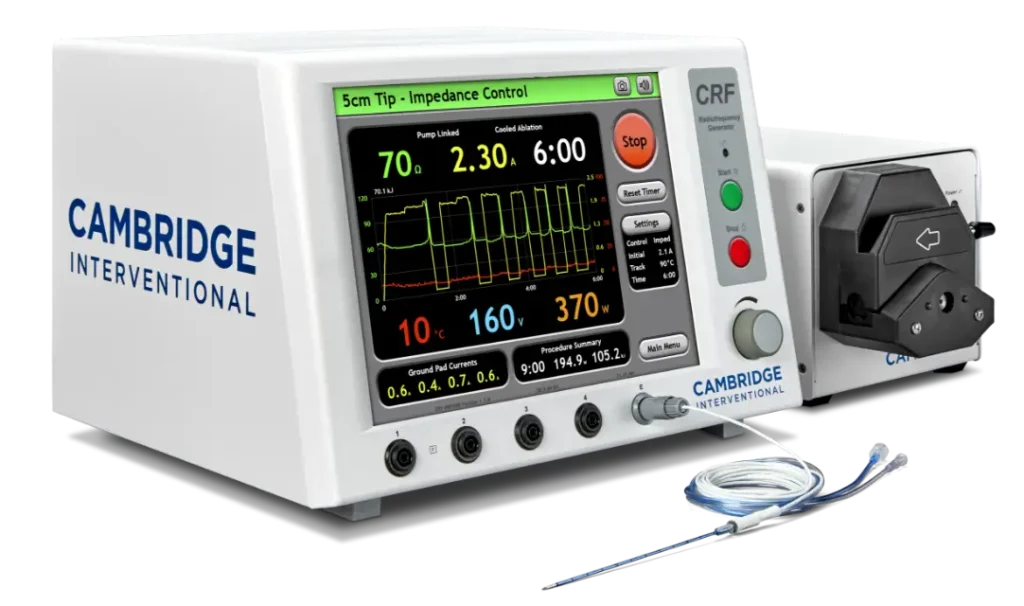
Backed by over 70 years of expertise, the Cambridge CRF System empowers clinicians to perform radiofrequency ablation with confidence across a wide range of applications in the thyroid, liver, kidney, bone, lung, and beyond. Its advanced algorithms, high power output, and superior usability work together to enable large, controlled ablations, streamlining complex procedures and delivering results beyond the limits of other RFA systems.
The CRF RFA System is engineered to support a broad range of ablation procedures using the same platform and electrode technology.
From thyroid to bone, liver, kidney, and lung procedures, the CRF RFA System supports consistent, controlled ablation across multiple applications using a single platform.
Indications for use: The CRF radiofrequency ablation system of Cambridge Interventional LLC (“Cambridge”) is intended for use in percutaneous, laparoscopic and intraoperative coagulation and ablation of tissue.
Disclaimer: Read the instructions for use (“IFU”) of all medical devices prior to use. Clinical results, ablation sizes, costs, and financial/insurance coverage may vary and are not guaranteed. The information contained in the multimedia content that is posted on the Cambridge Interventional website or that references or links to this text (“Content”) is for general informational purposes only and is not intended to be a substitute for professional medical advice, diagnosis, or treatment; standards of medical care or training; or the instructions, indications, and contraindications for use of Cambridge Interventional devices or any other medical devices. All information is provided in good faith, however Cambridge makes no representation or warranty of any kind, express or implied regarding the accuracy, applicability, fitness, or completeness of this information; of opinions expressed; of third-party publications referenced or summarized; or of third-party services presented. Always seek the advice of your physician about a medical condition. Never disregard professional medical advice, or delay in seeking it, because of something you have read or seen in this Content.
Adverse events: Reported adverse events or complications for RF ablation or coagulation procedures include, but are not limited to, the following (the long-term risks of RF ablations have not been established): abscess, ARDS (acute respiratory distress syndrome), arrhythmia, ascites, atrial fibrillation, bile duct injury, bile leakage, biliary fistula, biloma, bleeding, bone degeneration, bone fracture, bronchial occlusion, bronchopleural fistula, burn, cardiac arrhythmia, cardiac ischemia, chest tube, coughing, death, delayed hemorrhage into ablated tissue, device failure, device fracture in patient, diaphragm injury, diarrhea, edema, electric shock, emphysema, fever, fistula, hematoma, hematuria, hemoglobinuria, hemoptysis, hemorrhage, hemothorax, hoarseness, hypertension, hyperthyroidism, hypoesthesia, hypotension, hypothyroidism, infection, kidney atrophy, liver failure, liver insufficiency, multiple sclerosis exacerbation, muscle burn, muscle contracture, nausea/vomiting, nerve injury, neuropathy, nodule rupture, organ damage, pain, paresthesia, perforated colon, perforation, peritonitis, pes equinus injury, pleural effusion, pneumonia, pneumothorax, renal failure, skin burn, tumor recurrence, tumor seeding, urinary fistula, urinary incontinence, urinary retention, urine leakage, vasovagal reaction, vessel injury, vocal cord palsy, voice change, wound discharge. RF ablation procedures are not recommended for pregnant patients. Potential risks to the patient and/or fetus have not been established. General clinical residual risks for surgical procedures include anesthesia reaction, bleeding, blood clots, death, infection, organ injury, pain, and necessity for more invasive surgery, including open surgery, if complications occur.